Twice the work, half the time?
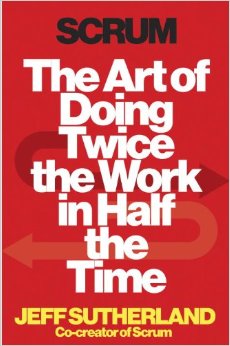
I had the pleasure to pick the book: The Art of Doing Twice the Work in Half the Time by JJ Sutherland. Needless to say it was a great read. It was great to hear from one of the founders of scrum how and why it came to be. Since my work is going through some pains in getting agile and scrum running smoothly I was asked to share a presentation based on the book. Keep reading or check out the presentation here.
1. Old Way
Waterfall
try to plan it all out
gantt charts
limited customer interaction
Why doesn't this work?
Doesn't account for change
People are bad at estimating
Doesn't solicit feedback
Usually we don't know everything
2. New Way
SCRUM
Evolutionary
Adaptive
Self Corrective
Small teams
Prioritized tasks
Daily stand-ups
Why does this work?
Encourages improvement
Encourages feedback
Eliminates waste
Usually we don't know everything
Makes people happy
You must plan for change & fail fast
You want to figure out what you don't know
You want to discover problems as soon as possible
Proven to deliver
Fewer people
Less time
More stuff
Higher quality
Lower cost
3. Teams
Great teams are:
Autonomous
Cross functional
Empowered
Small (7 +/- 2)
4. Time & Waste
"Time is finite, treat it that way."
No more meetings
one 15 minute standup
No multi-tasking
It makes you stupid and you are worse at both tasks
Context switching is difficult and takes time
Do it right the first time
Half done isn't done
Fix issues right away
It costs less and saves time
Sustainability
Working long hours gets less done
Don't be unreasonable
No heroics
No stupid policies
Examples
Toyota
Medco
5. Planning
Plan for reality not fantasy
Only plan what you need to do
Break your work into stories
As a (who)
I need (what)
So that (why)
Stories should be small
Independent
Negotiable
Valuable
Estimable
Small
Testable
Use relative sizing
People suck at absolute sizing
People are good at relative sizing (story points)
Velocity
When you know how fast you are going you will know when you are going to get there
Are you improving?
When SCRUM is implemented well production can increase substantially
6. Priorities
Delivering value...
Make a list and check it twice
Make a list of everything for the project and prioritize it
Highest value and lowest risk at the top
Minimum Viable Product (MVP)
80% of the value is in 20% of the work
The Product Owner
What needs to be done and why you should do it
The Team
How to make it happen and who should do it
Money for nothing and change for free
Create new things only as long as they deliver value
Be willing to swap them for things of equal effort
What is needed in the beginning is never what is actually needed
7. Happiness
"Too often we just reward results, but what we really want to reward is people striving towards greatness"
Why is happiness important
Smarter decisions
More creative
Retention
Accomplish more
Are we getting better?
Every sprint we should be trying to get better at something
Transparency
Secrecy is poison
Comments